

The Setup
Meridian was a mid-sized SaaS company; three years into a product that had found its market.
The platform worked. Users paid. Renewals were solid.
But underneath the healthy dashboard; something was deteriorating.
Response times were increasing. Edge cases were multiplying. The support queue was growing faster than the team could clear it. Engineers were spending more time investigating production issues than building anything new.
The foundation was cracking.
Not dramatically. Not visibly. Just quietly — the way foundations crack when nobody is looking at them.
The Decision
Leadership looked at the numbers and saw opportunity.
Retention was high. NPS was positive. The sales pipeline was full of prospects who wanted features the product didn’t have yet.
So they made what seemed like the obvious call:
“We need to accelerate. More features; faster delivery; bigger roadmap.”
They hired three new engineers. They restructured the team into two squads. They introduced OKRs with ambitious targets for the quarter.
The team; which had been quietly signaling that something was wrong; received the message clearly:
Build. Ship. Deliver.
So they did.
What Happened
The new features shipped.
And the foundation cracked faster.
Every new feature added complexity to a system that was already struggling to hold its weight. Every sprint added code to a codebase that needed less code; not more. Every delivery introduced new surface area for the bugs that were already multiplying beneath the surface.
The engineers knew.
They raised it in retrospectives. They flagged it in planning meetings. One senior developer wrote a detailed technical document outlining the stabilization work that needed to happen before any new features were added.
The document was acknowledged. Placed in the backlog. Prioritized “next quarter.”
The sprint board kept moving.
The Breaking Point
Six months after the acceleration decision; a major enterprise client experienced a critical outage.
Three hours of downtime. A formal incident report. A heated call with the account team.
The client didn’t churn. But they demanded a remediation plan — and a freeze on new features until the stability issues were resolved.
Leadership finally stopped.
And for the first time; asked the question that should have been asked eight months earlier:
“What type of work does this team actually need to be doing right now?”
The answer was obvious to everyone in the room.
It had been obvious for a long time.
The Diagnosis
Meridian’s engineering team was not a Fishing Vessel.
It was an Oil Tanker — a system where stability was everything; where the cost of an error was measured not in lost sprints but in lost clients; where the work required precision and patience; not velocity and volume.
But it had been led like a Fishing Vessel.
Fast iterations. Aggressive roadmap. Features over foundation. Velocity as the primary metric.
The OKRs measured what was delivered.
Nobody had defined what the season required.
And the season required something completely different from what was being asked.
What a Compass Would Have Changed
Before the acceleration decision; one conversation could have changed everything.
Not a longer planning session. Not a more detailed roadmap. Not better OKRs.
One question:
“What type of ship are we right now — and what does success look like in this season?”
The answer would have been uncomfortable. It would have meant telling the sales team to slow down the pipeline. It would have meant explaining to investors why the roadmap was pausing. It would have meant three months of work that produced nothing visible on a dashboard.
But it would have prevented six months of accelerating damage — and one very expensive enterprise outage.
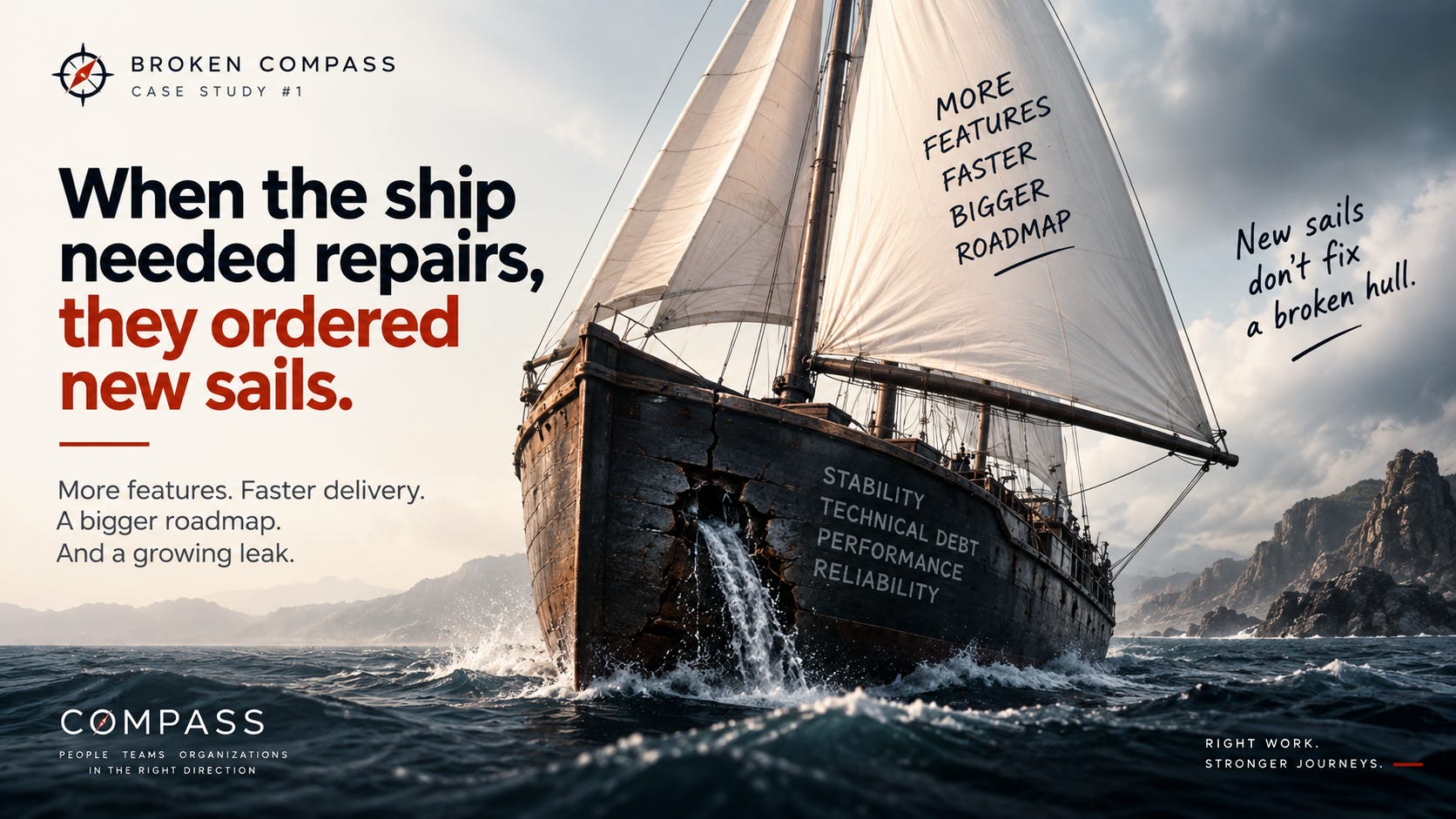
The ship needed repairs.
They ordered new sails.
And then wondered why it was taking on water.
The Navigation Note
Every organization has seasons when the most valuable thing a team can do is invisible on a sprint board.
Stabilizing. Reducing debt. Rebuilding the foundation.
This work doesn’t show up in velocity charts. It doesn’t make it into the OKR review. It doesn’t impress investors or excite sales teams.
But without it; everything built on top of it eventually costs more to fix than it would have cost to pause.
The Broken Compass in this story wasn’t a bad team or a bad leader.
It was the absence of a shared language for naming what season the team was actually in — and the courage to lead accordingly.
Have you ever watched an organization push for innovation when what was needed was repair?
What made it hard to say so — and what finally made it possible?
🧭 Broken Compass is a series of case studies on what happens when teams; leaders; and organizations navigate without a compass.
Note: Meridian is a fictional company. Names; industry; and specific details have been changed. The patterns described are real — drawn from situations I’ve encountered across teams and organizations over the past decade.
🔔 Follow Teofil Lucaci on LinkedIn for weekly navigation insights.