

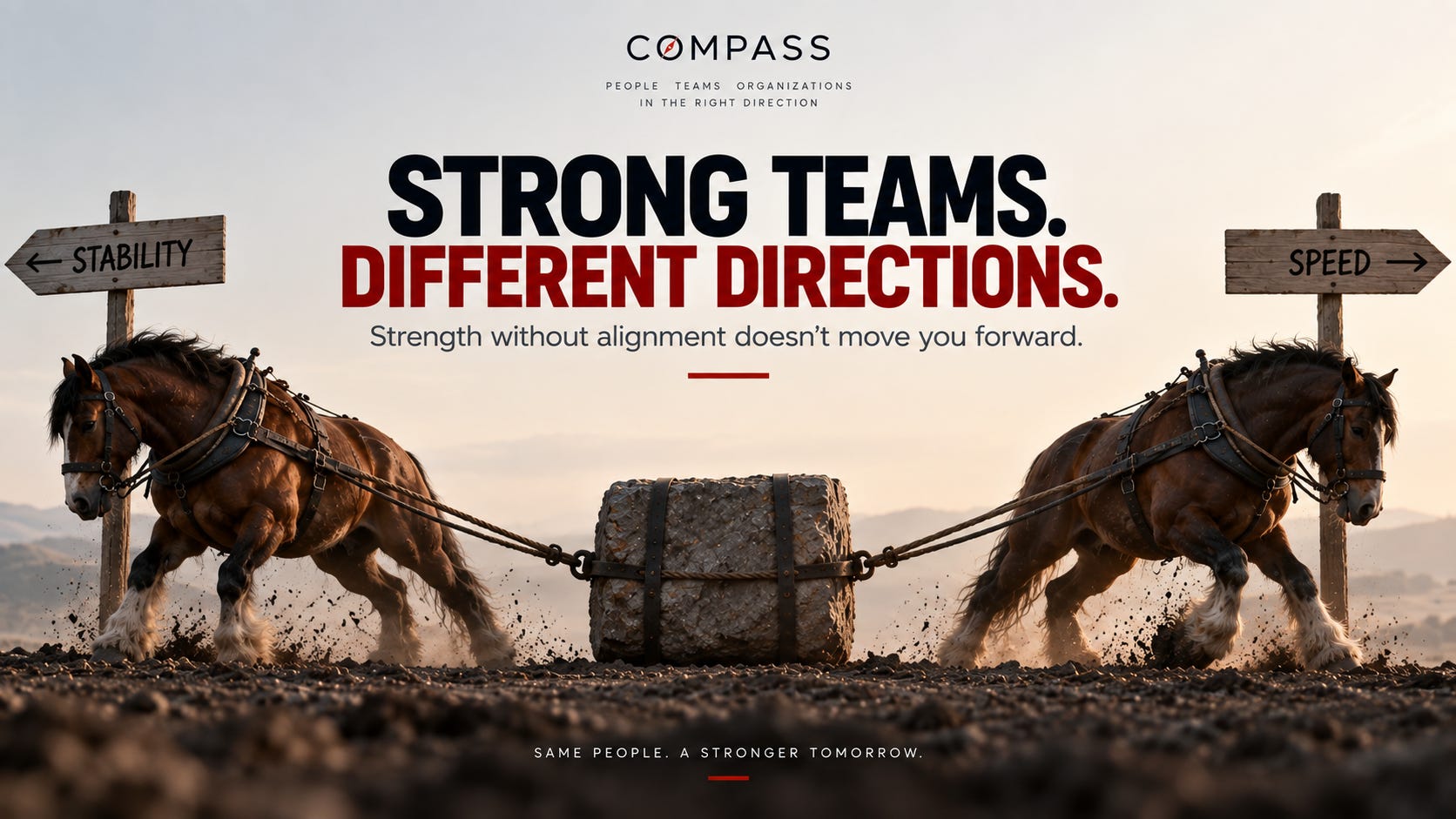
There’s a story often told about Belgian draft horses.
They are among the strongest horses on earth. Bred for plowing, hauling, and farm work. One of them, the story goes, can pull around 8,000 pounds.
Put two together and you’d expect 16,000. Maybe a little more.
Instead, when they pull together, they move something closer to 24,000.
The exact numbers vary depending on who tells the story. The principle doesn’t.
But there’s a detail most people skip:
It only works when both horses pull in the same direction, at the same rhythm, in the same harness.
Put two of the strongest horses in the world side by side, pulling toward different points, and you don’t get 24,000 pounds.
You get a wagon that barely moves. And two exhausted horses.
The Setup
Kestrel was a growing software company with two exceptional teams.
The Platform team was known for reliability. Careful, methodical, proud of zero critical incidents in eighteen months.
The Growth team was known for speed. Experiments every week, fast launches, a habit of turning ideas into revenue.
Both were the best at what they did.
So when leadership decided to launch a new flagship product, the decision seemed obvious:
Put our two strongest teams on it together.
What Happened
On paper, it was the perfect combination. Stability and speed. Discipline and innovation.
In practice, the teams pulled in opposite directions from week one.
Platform wanted architecture reviews before anything shipped. Growth wanted a prototype in users’ hands within ten days.
Platform measured success by what didn’t break. Growth measured success by what got launched.
Every planning meeting became a negotiation. Every decision needed two approvals. Every release carried the frustration of one team feeling slowed down, and the other feeling rushed.
Nobody was wrong. Nobody was lazy. Everybody was working hard.
That was the problem.
Two strong horses. Two different directions. Full effort, pulling against each other.
The Breaking Point
Four months in, the flagship product was behind schedule.
Leadership asked for an explanation. Each team gave one, and each explanation quietly pointed at the other.
Two senior engineers asked to transfer out. The Growth lead said, in a retrospective nobody forgot:
“Separately, we were the best teams in this company. Together, we’re the slowest.”
The Diagnosis
Kestrel didn’t have a talent problem. It didn’t have a collaboration problem.
It had a direction problem.
Each team arrived with its own compass, calibrated for its own ship. Platform was an Oil Tanker: stability first, error unacceptable. Growth was a Fishing Vessel: iterate fast, learn from users.
Both compasses were correct. For their original ships.
But nobody sat down at the start and answered the question that would have turned two strong teams into one stronger fleet:
“What type of work does this product actually need right now, and what does a good month look like for all of us, together?”
Without that answer, each team kept navigating by its own north.
And two correct compasses pointing in different directions produce the same result as a broken one.
What a Compass Would Have Changed
The multiplier in the horse story isn’t strength. It’s alignment.
The same harness. The same direction. The same rhythm.
For Kestrel, that would have meant one conversation before the first sprint:
Name the season: early product, closer to a Fishing Vessel, with clear limits on what Platform must protect.
Define one shared direction for the quarter, in one sentence both teams could repeat.
Agree on one definition of success: “This month was good if ___.”
Decide explicitly what neither team would do yet.
Not a reorg. Not a new process. A shared north, set deliberately, before the pulling started.
The Navigation Note
We tend to believe that combining strong people automatically creates stronger results.
Sometimes it does. When they share a direction, it can multiply what each could do alone.
But strength without shared direction doesn’t add up. It cancels out.
The Broken Compass in this story wasn’t a weak team.
It was two strong ones, each following a north that made sense for them, and nobody defining the north that made sense for both.
Have you ever watched two strong people or teams achieve less together than they did apart?
What was missing: talent, or direction?
🧭 Broken Compass is a series of fictional case studies. Names and details are invented to protect the people involved, but every pattern is drawn from real organizational behavior.
I’m opening the first cohort of Compass navigators.
A small group of leaders and professionals who want to learn to navigate together: define their north, name their season, and stop pulling hard in directions that don’t add up.
If you want to be part of the first edition, you’ll find the details at compass.training or send me a DM with the word “cohort”.