

Did you know that speed can kill a product?
I remember the day I realized this — not from a book, not from a course, but from my own mistake, lived in real time.
We were a small team launching a new product. A colleague had done solid research: the need was real, the market was there, the timing seemed perfect. We brought together experienced people, chose the right technologies, and got started. High energy, total focus, fast execution.
After a few iterations, we had an MVP. Users showed up. The response was positive. We accelerated.
As we moved forward, small bugs appeared. We logged them, documented them — and deferred them. The reasoning was simple and, at the time, seemed sound: future releases will fix the minor issues. Right now, our focus is speed of delivery.
We were agile. We were fast. We were closing sprint after sprint.
And we were building, without knowing it, a time bomb.
When Speed Becomes a Weapon Against You
The small problems didn’t go away. They accumulated. And at some point, our platform became frustrating for anyone trying to do anything more complex than a basic action.
Any advanced report returned inconsistencies. Any combination of data became unreliable. Users no longer trusted the numbers they were seeing — and without trust in data, a tech product has no argument left.
People stopped using us.
The effort to repair the damage — technical and relational — was ten times greater than it would have been had we fixed the problems in time. And the user feedback we had ignored in our race for speed turned out to be a gold mine. When we finally stopped to listen, we discovered solutions we hadn’t seen — and felt the sting of knowing they had been within reach all along.
Throughout this entire period, I lived with a quiet, persistent internal conflict. I knew this speed could be fatal if we hit an obstacle along the way. And yet I kept going, caught inside the logic of the system.
You can drive at 80 mph. But that speed is for the highway. On a narrow mountain road, that same 80 mph turns any small obstacle — a rock, an unexpected curve — into a fatal accident.
We were building a product on a mountain road. And driving like we were on a highway.
The Illusion of Productivity
A few months later I found myself in a completely different phase — research. I was trying to solve a new challenge, with no clear solution in sight.
Entire days of reading articles, taking notes, watching videos, listening to experts who had faced similar problems. It was slow, diffuse work, with no visible deliverables at the end of the day.
And I felt terrible about it.
In the evenings, looking back at the day that had passed, I felt like I had wasted my time. I hadn’t checked anything off. I hadn’t delivered anything. I hadn’t produced anything measurable.
The irony? Looking back now, that period was one of the most productive of my career. The connections I formed then, the understanding I built in those seemingly lost days — they underpinned decisions that mattered enormously later on.
But in that moment, my evaluation system was lying to me. I was judging myself by the wrong metrics for the season I was in.
Work Has Seasons
The revelation didn’t come from a single moment. It came from many, gathered over time, until the picture became clear.
Work, I realized, unfolds in seasons — just like nature.
Sometimes you’re in a speed season: the market is moving, the window is narrow, agility is a superpower. You deliver fast, adapt fast, iterate without stopping.
Other times you’re in a season of careful navigation: the waters are murky, visibility is low, every maneuver matters. Speed doesn’t help you — it kills you. You need patience, attention, the ability to read small signals before they become crises.
Other times you’re in a season of strict discipline: procedures exist for a reason, an apparently minor error can trigger a chain of disasters. Improvisation is the enemy, not the ally.
The problem isn’t that one of these seasons is wrong. The problem is when you apply the metrics of one season in the middle of another.
When you measure research by sprint standards — speed, deliverables, visible output — you will always feel behind, even if you’re building something essential.
When you measure careful navigation by highway speed, you accelerate exactly when you should be braking.
The Question We Never Ask
The tech industry — and beyond — is obsessed with methodologies. Scrum. SAFe. OKRs. Kanban. Lean. Each one promises that if you apply it correctly, you’ll deliver faster, better, more consistently.
And many of them actually work. That’s not the problem.
The problem is that all these methodologies tell you how to move. The speed, the rhythm, the process, the ceremonies.
But none of them ask you the first thing that should be asked:
What season are you in? And where are you going?
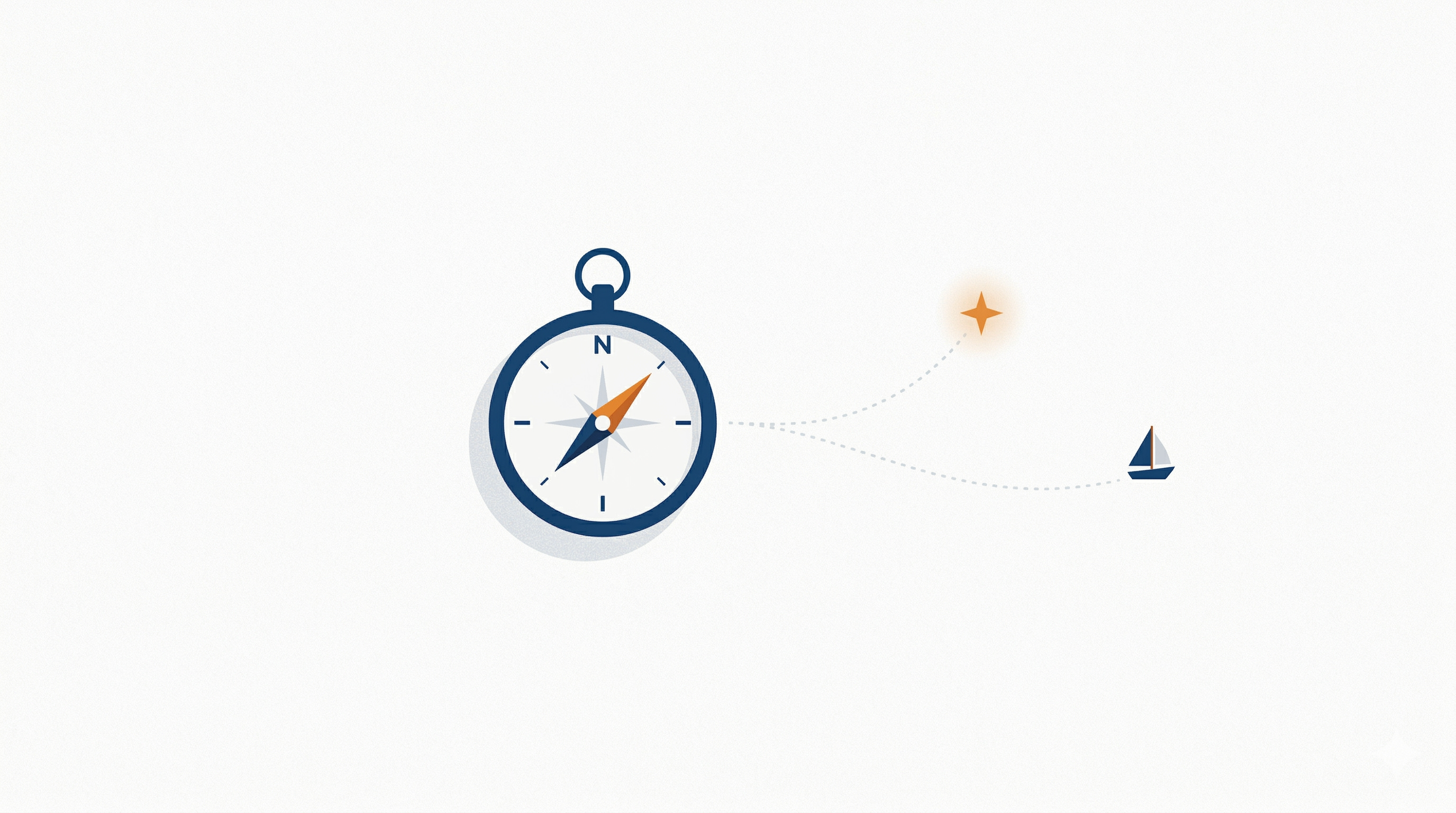
A high-performance vehicle, driven in the wrong direction, gets you faster to a place you never wanted to be. A fifteenth-century navigator could have the best oars, the most disciplined crew, the most efficient watch rotation system — and still die in the ocean if he didn’t know where north was.
Your metrics today — tasks checked off, sprints closed, team velocity — are the oars. They are not the compass.
Let Me Ask You Something
Think about your last week of work.
Were you busy? Almost certainly. Did you deliver things? Probably. Did you feel like you were genuinely moving toward something that matters?
If the answer to that last question came harder than the others — you’re not lazy, you’re not disorganized, and you don’t need another productivity system.
It’s possible the problem isn’t how hard you work.
It’s possible the problem is that you’re measuring the wrong things for the season you’re in.
Next I’m writing about what a true north looks like — and what it means to navigate with a compass, not just a more powerful engine.
If this article described something you’ve felt too, give it a follow. Let’s continue the conversation.